
Scaling of magnetization with temperature
Temperature dependencies in magnetism are always somehow tricky and involve many model assumptions. The behavior of magnetization (or sublattice magnetization for antiferromagnets) is of special interest since it gives a hint for scaling of other material parameters.
There is a seminal Bloch’s 3/2 law that can be used as a good approximation for bulk ferromagnets (Aharoni96). It comes from the consideration of spin waves on the background of the uniform state that effectively scale the average moment per unit volume. After some math for a cubic bcc ferromagnet, the resulting scaling of the saturation magnetization \(M_S\) with temperature \(T\) is
\[\dfrac{M_S(T)}{M_S(0)} \approx 1 - 0.0104 \dfrac{1}{S} \left( \dfrac{k_\text{B}}{\hbar^2 SJ} \right)^{3/2} T^{3/2},\]where \(k_\text{B}\) is the Boltzmann constant, \(\hbar\) is the Planck constant, \(S\) is the spin length, and \( J \) is the exchange integral. Other lattices may have different numerical prefactors. However, considering the real ferromagnet the saturation magnetization at 0K and the critical temperature \(T_C\) of transition to the paramagnetic state are the fitting parameters, and the Bloch formula can be improved as follows (Kuzmin05), (Kuzmin20):
\[\dfrac{M_S(T)}{M_S(0)} = \left[ 1 - s \left(\dfrac{T}{T_C}\right)^{3/2} - (1-s) \left(\dfrac{T}{T_C}\right)^p \right]^{1/3}\]where \(s > 0\) is one fitting parameter, and another fitting parameter can be taken as \( p = 5/2 \) in many cases. These dependencies can be used to estimate the exchange stiffness. Since the practically relevant case nowadays includes thin films, one should keep in mind that the spin-wave-based analytics of Bloch 3/2 law is modified there because of geometric confinement, and generally, the power 3/2 can change.
We work a lot with antiferromagnets, with a special focus on α-Cr2O3 (chromia). There, DFT and experimental estimates agree with the sublattice magnetization at 0K to be \( M_S \approx 530 \) kA/m (note that it includes two magnetically equivalent Cr ions within the four-Cr unit cell!) (Samuelsen70), (Pylypovskyi24). The bulk critical temperature of transition to the paramagnetic state is 308K. And within this range, there is a nice fit of the experimental measurements given by the analytical expression (Hoser12):
\[\dfrac{M_S(T)}{M_S(0)} = \begin{cases} 1 - 0.555 \left(\dfrac{T}{T_C}\right)^{3} & T < 250\text{ K} \\ 0.893 \left[1 - \left(\dfrac{T}{T_C}\right)^{3} \right]^{0.314} & T > 250\text{ K} \end{cases}\]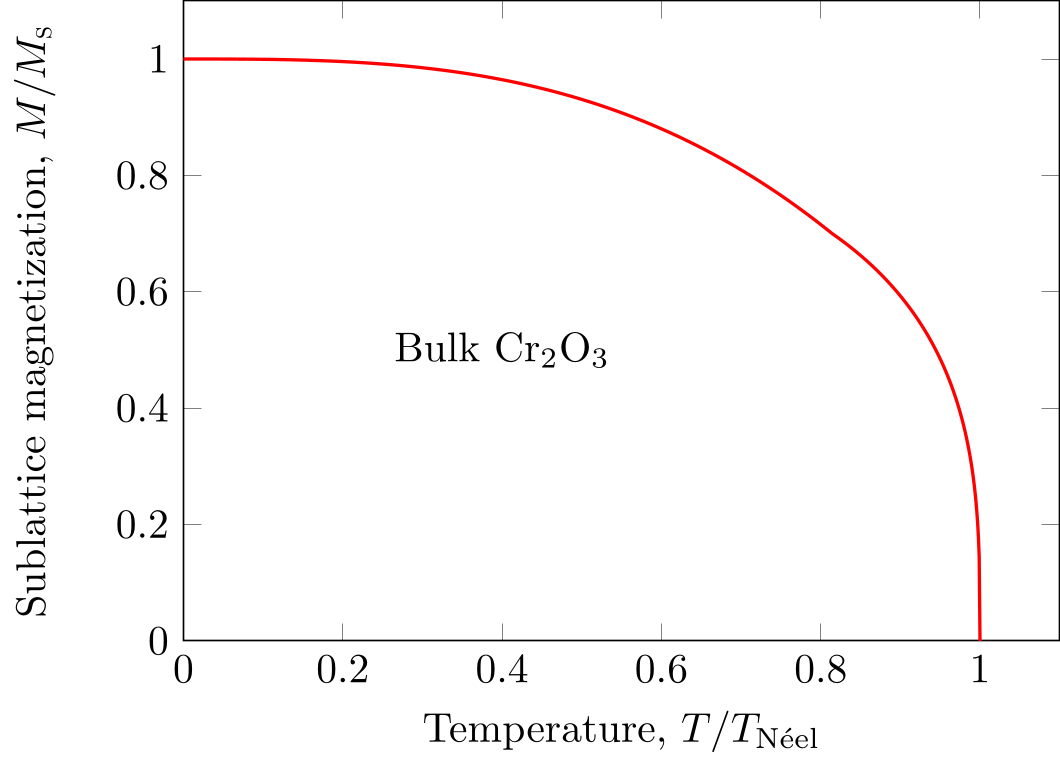
References
- (Samuelsen70) Samuelsen, E., Hutchings, M. and Shirane, G. Inelastic neutron scattering investigation of spin waves and magnetic interactions in Cr2O3, Physica, 48, 13–42 (1970) DOI:10.1016/0031-8914(70)90158-8
- (Aharoni96) Aharoni, A. Introduction to the theory of Ferromagnetism, Oxford University Press (1996)
- (Kuzmin05) Kuz’min, M. D. Shape of Temperature Dependence of Spontaneous Magnetization of Ferromagnets: Quantitative Analysis, Physical Review Letters, 94, 107204 (2005) DOI:10.1103/physrevlett.94.107204
- (Hoser12) Hoser, A. and Köbler, U. Renormalization Group Theory, Springer Berlin Heidelberg (2012)
- (Kuzmin20) Kuz’min, M. D., Skokov, K. P., Diop, L. V. B., Radulov, I. A. and Gutfleisch, O. Exchange stiffness of ferromagnets, The European Physical Journal Plus, 135, 301 (2020) DOI:10.1140/epjp/s13360-020-00294-y
- (Pylypovskyi24) Pylypovskyi, O. V., Weber, S. F., Makushko, P., Veremchuk, I., Spaldin, N. A. and Makarov, D. Surface-Symmetry-Driven Dzyaloshinskii-Moriya Interaction and Canted Ferrimagnetism in Collinear Magnetoelectric Antiferromagnet Cr2O3, Physical Review Letters, 132, 226702 (2024) DOI:10.1103/physrevlett.132.226702